


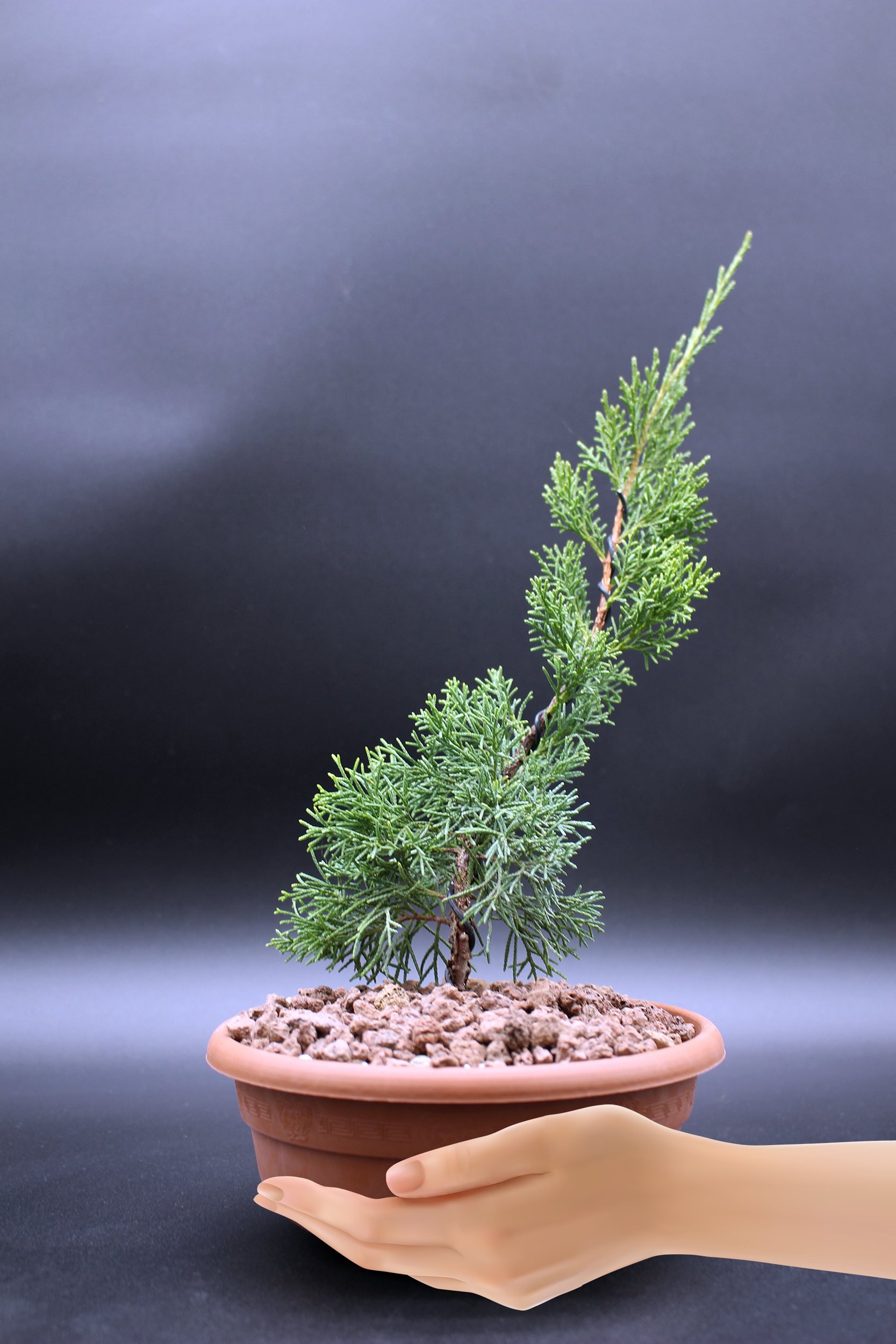
Chinese Kishu Juniper Pre Bonsai (Juniperus Chinensis Kishu)
49,99 €
Chinese Kishu Juniper (Juniperus Chinensis Shimpaku var. Kishu) Pre Bonsais in different sizes and shapes
Description
Juniperus chinensis ‘Kishu’ is one of the most valued juniper cultivars in bonsai cultivation. Known for its compact foliage, rich green color, and strong response to pruning, it is frequently used to create refined bonsai trees. The transformation of a Kishu juniper from a simple cutting into a beautiful pre bonsai is a process that requires patience, planning, and careful cultivation over several years.
The journey begins with a healthy cutting taken from a mature Kishu juniper plant. Cuttings are usually taken from semi-hardwood growth during late spring or summer when the plant is actively growing. A cutting of about 10 to 15 centimeters is selected, preferably from a branch with strong foliage and no signs of disease or weakness. The lower foliage is carefully removed to expose the stem that will be inserted into the rooting medium. Many growers dip the base of the cutting into rooting hormone to increase the chances of successful root development.
The prepared cutting is then placed in a well-draining propagation mix, often made from sand, perlite, pumice, or a mixture designed to maintain moisture while allowing air to reach the developing roots. Consistent humidity is important during this stage. The cutting must be kept moist but not waterlogged, and it is often placed in a shaded area or under a propagation dome to reduce water loss through the foliage. Over the course of several weeks or months, fine roots begin to form at the base of the cutting.
Once the cutting has developed a stable root system, it begins its first stage as a young plant. At this stage it still resembles a small shrub rather than a bonsai, but it already contains the genetic characteristics that make Kishu so desirable. The young plant is gradually introduced to more sunlight, encouraging strong growth and dense foliage. During this period the focus is not yet on refinement, but on developing health and vigor. Strong roots and steady growth form the foundation for all future bonsai work.
After a year or two of growth, the young juniper can be transplanted into a slightly larger container with a free-draining bonsai soil mixture. This soil often contains materials such as pumice, akadama, and lava rock, which provide both moisture retention and aeration. As the roots expand and the trunk begins to thicken, the plant starts to show the first signs of potential as a bonsai.
The next important step in the transformation is early styling. At this stage the grower studies the plant carefully to determine the most promising trunk line and overall direction of the future tree. Young junipers are flexible, which allows the trunk to be gently wired and bent into an interesting shape. Movement in the trunk is essential for creating a natural and dynamic bonsai appearance. Subtle curves or more dramatic bends can be introduced depending on the vision for the tree.
Primary branches are selected during this stage. Some branches are kept to form the future structure of the tree, while others are removed to simplify the design. Care is taken not to remove too much foliage at once, as junipers rely on their foliage for energy production. The remaining branches are wired and positioned to begin forming the basic framework of the future bonsai.
Over the next several years, the plant continues to grow and strengthen. Regular pruning encourages back budding and denser foliage pads. Kishu junipers respond particularly well to careful pinching and thinning, which helps maintain compact growth. The trunk gradually thickens, and the bark begins to develop a slightly rougher texture, adding character and a sense of age.
During this development stage, the plant may be moved between training pots or grow boxes to accelerate trunk development. These containers allow more root growth than a small bonsai pot, helping the tree gain strength and thickness more quickly. Periodic repotting also allows the grower to begin shaping the root system so that attractive surface roots, known as nebari, can eventually form.
As the tree matures, secondary branching begins to develop from the primary branches that were chosen earlier. These smaller branches are trained to create layered foliage pads, a characteristic feature of juniper bonsai. Wiring continues to refine the position of branches and create depth in the design. The goal is to create a structure that looks balanced and natural from every viewing angle.
Eventually, after several years of growth, pruning, and careful training, the once simple cutting has transformed into a pre bonsai. At this stage the tree has a defined trunk line, a developing branch structure, and enough character to resemble a miniature tree rather than a young plant. While it may still require further refinement before becoming a finished bonsai, it already carries the essential elements of maturity and design.
The transformation of a Juniperus chinensis Kishu cutting into a beautiful pre bonsai is a gradual and rewarding process. It demonstrates how patience and attentive care can shape living material into a work of horticultural art. From a small piece of stem to a structured young tree, the journey reflects the core philosophy of bonsai: guiding natural growth while respecting the character of the plant itself.
Scientific name: Juniperus Chinensis Shimpaku var. Kishu
Common Name: Chinese Kishu Juniper
Origin: Japan
Growth height: maximum 1 meter
Stage of development: Pre Bonsai
Delivery form: Bonsai pot ⌀ 17 cm
Additional information
| Weight | N/A |
|---|---|
| Number | # 1, # 2, # 3, # 4, # 5 |
Related products
-
 Select options This product has multiple variants. The options may be chosen on the product page
Crassula Ovata Pre Bonsai – (Jade plant)
49,99 € -
 Select options This product has multiple variants. The options may be chosen on the product page
Ficus Microcarpa ‘Tiger Bark’ Pre Bonsai
49,99 €